
Timeline Notes I: Şebnem Ferah, a Vacuum Cleaner Ad, and Performative Loyalty
This week’s timeline wrap-up suggests that Turkey’s social media no longer merely tracks the agenda; it increasingly functions as a mechanism for testing who performs loyalty to the symbolic boundaries drawn by power, and how visibly.
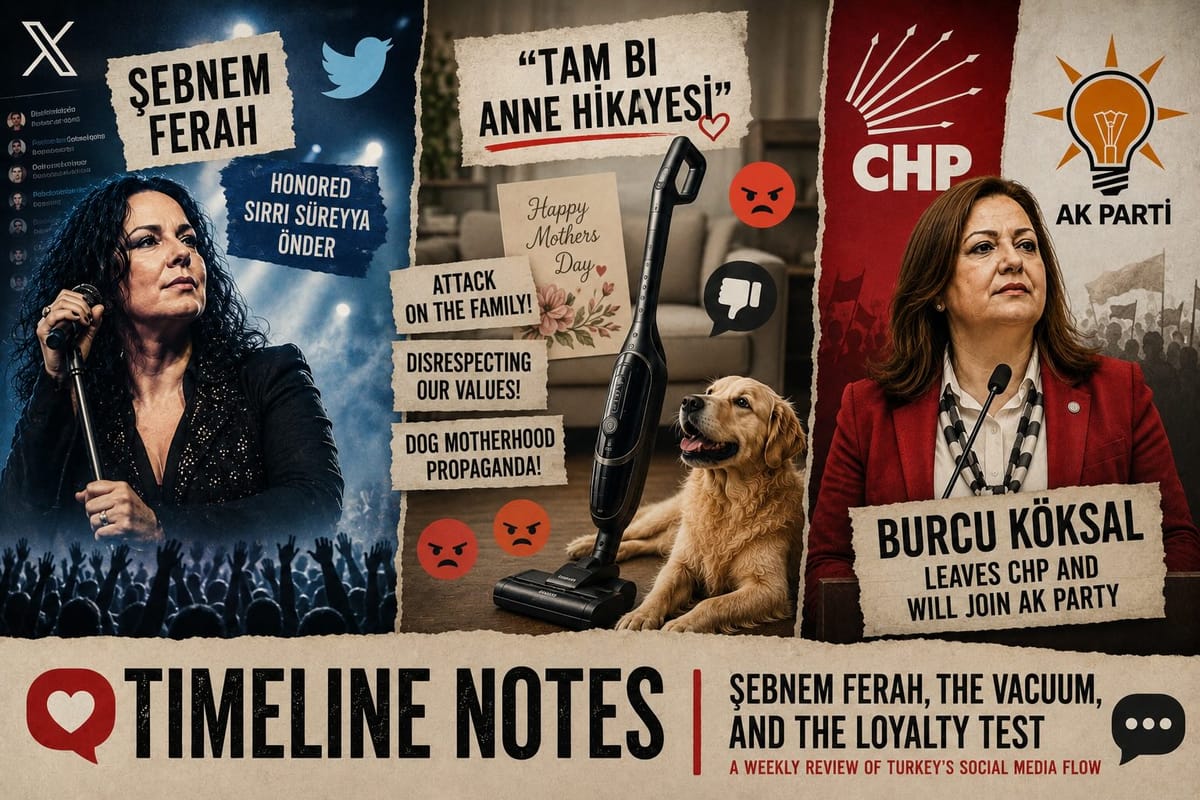
For some time now, because of the pressure of other work, I have not been able to write on the blog as regularly as I would have liked. To break that passivity a little and bring the blog back into motion, I want to begin a series that I will try to sustain weekly: Timeline Notes. In this series, I will reflect on the debates, unexpected ruptures, and seemingly ordinary events that stand out each week on social media—especially on the Twitter/X timeline, which I have followed closely for a long time—but which also carry broader social and political meanings. My aim is not to exhaust the week’s entire agenda; in Turkey, keeping up with the whole agenda is almost impossible anyway. Rather, I want to think through a few events that surface in that week’s flow and ask how social media in Turkey shapes public life, political positions, and expectations of loyalty.
What surprised me most in this week’s social media flow was not that Şebnem Ferah was returning to live performance after many years, but that this return was turned into a political loyalty test before the concert had even taken place. Under normal conditions, this would have been an almost nostalgic event for several generations who grew up listening to rock music in Turkey. A Şebnem Ferah concert at KüçükÇiftlik Park after six years would normally have been discussed through ticket prices, how quickly tickets sold out, whether the old songs still resonated, or whether there would be a second date.
One of my favorite performances from Şebnem Ferah, her live performances have always been better than the album recordings.
In Turkey’s social media ecology, however, very little is allowed to remain in its original register for long. Almost every cultural event is quickly pulled into a political system of signs. A concert announcement does not remain a concert announcement. A like, a condolence message, a silence, a follow, an old photograph, even an emoji can be turned into evidence. This is what happened in Şebnem Ferah’s case. The return of an artist who had not performed for years was soon debated through the fact that she had commemorated Sırrı Süreyya Önder, or liked a post about him. The matter left the realm of music and became a question of who commemorates whom, who refuses to distance themselves from whom, and who has violated which emotional or political boundary.
What surprised me here was not only the reaction itself, but the figure toward whom it was directed. In the memory of my generation, Şebnem Ferah was never a directly political figure. Of course, like any artist, she had a worldview, a sensibility, and a public presence. But for those of us who grew up listening to her, she was first and foremost one of the strongest voices of the Turkish rock explosion from the late 1990s onward. If anything, the way we remembered her was largely “non-political”: inward-looking, dark, personal, emotional, but not directly political. Among her peers, she could even be considered apolitical.
For me, this memory goes even further back. When I first started at Gazi Anatolian High School, at around ten and a half or eleven, I was discovering rock music seriously for the first time. Metallica tapes, Guns N’ Roses albums, magazines passed from hand to hand, half-remembered information, music stories circulating among friends… At that age, rock music in Turkey was not the endless archive that algorithms now place before us. Even hearing the name of a band was an event. Who had played where, who had left which band, who had released which album—these were often fragments made of rumor, excitement, and discovery.
That was how I first heard of Şebnem Ferah. Was it in Rock Kazanı or Rock magazine, or in the very limited rock pages of Blue Jean? We learned that she had played in an all-women rock band with Özlem Tekin. At the time, with the language of the period, we did not say “women’s rock band” with today’s sensibilities; we said something more like “girl rock band.” The band’s name was Volvox. The fact that they came out of Bursa, and that there was a band composed of women in the Turkish rock scene, was already remarkable to us. In the early and mid-1990s, rock music in Turkey was still a semi-underground, semi-youth-culture field. Things that may look small from today’s perspective produced a genuine sense of discovery then.
There were other bands that drew our attention in those years. Athena, for instance, would later settle into an entirely different mass-cultural position, moving from football terraces to Eurovision, from ska-punk to the center of popular culture. But in its early period, what brought Athena onto our radar was not its later broad popular image, but a harder, punkier, more alternative line. Rock music in Turkey had not yet been packaged as today’s nostalgic “spirit of the 1990s.” It was more fragmented, more unruly, younger, and certainly far less institutional.
This is why the news of Şebnem Ferah’s return to the stage initially produced, at least for me, not a political feeling but a generational one. The return of a voice, the recollection of a period, a person’s encounter with his own archive of youth. Yet social media no longer lets such moments of memory remain memory for very long. It immediately attaches them to today’s wars of political positioning. An artist’s thirty-year musical existence can be judged anew, within a few hours, through a single gesture.
The issue here is not whether Şebnem Ferah can be criticized. Public figures can of course be criticized. The issue is the form and speed of the criticism. Social media, especially in Turkey, increasingly turns criticism into a loyalty test. What people say becomes less important than whose pain they acknowledge, whom they commemorate, whom they refuse to distance themselves from, which post they like. Political debate is thus organized less through content than through contact: “Whom did you touch?” “With whom did you appear in the same sentence?” “Whose mourning did you recognize as legitimate?”
This week’s Şebnem Ferah debate made me think primarily about this. In Turkish social media, there is now an invisible interrogation beneath almost every event: “Are you one of us, or not?” Sometimes the question is asked openly; sometimes it is inferred from likes, posts, and silences. But it is almost always there. And once it is asked, the artist’s music, past, place in generational memory, and even personal distance all become secondary.
The Holy Family and the Vacuum Cleaner Ad
At this point, the second example of the week was a Mother’s Day commercial by a foreign home-appliance brand. At first glance, this advertising crisis seemed unrelated to the Şebnem Ferah debate. In fact, it showed the same fault line breaking open from another point. The simple narrative of the ad was this: a woman encounters another woman in a home-appliance store; throughout the conversation, the ad invokes having children, caring for them, meeting their needs. At the end, it becomes clear that the being the woman speaks of with such affection is not a child, but her dog. The ad, released under the title “Tam bi’ anne hikayesi”—“A Real Mother Story”—was reported to have drawn backlash on social media and was later removed.
The ad is here via other sharers, though, the company already removed it completely.
Under normal conditions—and I use “under normal conditions” deliberately, because our generation knows the phrase from physics classes, the assumption that the physical environment will behave reasonably under constant pressure and temperature—such an ad would at most have produced a limited debate: “This is a bit forced,” “a vacuum cleaner ad for Mother’s Day is already a problem,” “is it right to equate pet ownership with motherhood?” In other words, it could have been criticized, mocked, or dismissed as bad advertising. What happened went well beyond that.
The advertisement, predictably enough, was not allowed to remain merely an advertisement. It was read as an attack on the family, an intervention into population politics, a devaluation of motherhood, an imposition of Western values, and, in some comments, as part of darker conspiratorial narratives. A simple commercial thus became one of the new frontiers of loyalty performance in Turkey. The question was no longer whether one liked or disliked the ad. It became a public call to order over the hierarchy in which the mother, the family, the child, animal love, and consumer culture may be mentioned.
The Obligation to Turn Loyalty into Performance
The crucial point is this: until recently, many people and institutions in Turkey assumed that they could exist within the social, cultural, and economic system without explicitly displaying their loyalty. Indeed, this was one of the most important things that separated Turkey from classical authoritarian regimes. Not everyone had to perform open loyalty at every moment. In everyday life, in our professions, in the institutions where we work, in the culture we consume, in the advertisements we watch, in the music we listen to, there was a certain gray zone. People and institutions could continue to exist without taking an explicit position on every single matter.
Now this gray zone is narrowing. It is not only politicians but artists, companies, advertising agencies, brands, academics, journalists, and even ordinary users who are expected to make their loyalties visible. More importantly, not displaying loyalty has itself become a suspicious position. In the past, not doing something could mean remaining neutral; today it often means standing in the wrong place, remaining silent toward the wrong person, failing to distance oneself from the wrong value.
The reaction directed at Şebnem Ferah and the reaction directed at the vacuum cleaner ad are, in this sense, two different appearances of the same social mechanism. In one case, an artist’s like; in the other, a brand’s advertising narrative is subjected to a loyalty test. Both show that social media in Turkey is no longer simply a space in which ideas circulate; it is becoming a roll-call mechanism that checks who is attached to which symbols, and with what degree of intensity.
This mechanism of inspection is not limited to pro-government circles alone. Different political camps in Turkey have produced their own loyalty regimes. Each camp has its sacred objects, untouchables, forms of mourning, objects of anger, and definitions of betrayal. Whom an artist commemorates, what model of family a brand implies, which party a politician joins, which concept an academic uses—all are quickly tied to the same question: “Are you one of us, or not?”
This is why this week’s flow made me think that social media in Turkey no longer debates events so much as possibilities of belonging. Şebnem Ferah’s return to the stage was a musical event; the vacuum cleaner ad was a commercial event. But both were transformed within hours into political-moral loyalty tests. Perhaps the genuinely new thing is this: in Turkey, it is increasingly not only what you do, but what you do not show openly enough, that is judged.
Burcu Köksal and the Passage of Right-Kemalism from the CHP to the AKP
The final example of the week was Burcu Köksal. The announcement that Köksal, the mayor of Afyonkarahisar, would break with the CHP and join the AK Party showed that the loyalty test is not operating only in the cultural field or through advertisements; it has also moved directly into the center of the political field. Here the issue was no longer a like or an advertising implication, but the explicit renegotiation of the relationship among the voter mandate, party belonging, local power, and political loyalty.
Of course, the matter also has cultural and ideological significance. The CHP, as it was reconstituted after September 12, long existed as a party in which right-Kemalism carried considerable weight and which defined itself within the limits of the established order. With Burcu Köksal’s departure, one can say that after March 19, 2024, the visible and effective figures of classical right-Kemalism within the CHP have almost entirely receded. Köksal’s move, therefore, is not merely a personal political preference or an instance of local power pragmatism; it is also an indication that the old statist-nationalist current within the CHP can be more easily articulated with the AK Party’s current statist-nationalist language.
Here, the Burcu Köksal case should be considered within a broader circulation of political cadres. A significant number of the nationalist, statist, right-Kemalist figures who mounted some of the harshest opposition to the AK Party after November 3, 2002 are today either directly within the AK Party or in the institutional orbit of the ruling bloc. Metin Feyzioğlu’s ambassadorial appointments, Mehmet Ali Çelebi’s and Hulki Cevizoğlu’s positions as AK Party members of parliament, Özlem Çerçioğlu’s move to the AK Party, and now Burcu Köksal’s incorporation into the same line cannot be seen merely as personal changes of route. This picture suggests that the AK Party, in terms of its cadre structure, now has to carry a right-Kemalist wing within itself.
The open question is whether this is a lasting ideological synthesis or a conjunctural alliance. Right-Kemalist cadres come to the AK Party with their own symbolic capital: the military, law, republicanism, secularism, nationalism, the survival of the state. In return, the AK Party offers them access to power, protection, visibility, and position. We do not yet know whether this exchange will turn into a lasting partnership or into a temporary cadre transfer to be used for as long as the government needs it. How much room will the host open for them, and how much will these figures be able to transform the ideological architecture of the host?
Instead of a Conclusion
In the case of Şebnem Ferah, a woman artist’s act of commemoration; in the vacuum cleaner ad, the representation of motherhood and family; in the case of Burcu Köksal, a woman politician’s move to the ruling party—all became connected within the same week’s flow. The three events seemed to belong to different fields: music, advertising, local politics. Yet their common ground was not only social media reaction; it was the loyalty that power demands from public life. From the woman artist returning to the stage, a proper form of mourning was expected; from the woman depicted in the ad, proper motherhood; from the woman politician, a proper political belonging articulated to the center of power.
By loyalty, I do not mean loyalty in the narrow sense of allegiance to a party, political line, or movement. I mean something broader and harsher: the obligation to conform to the value-world of power, to its imagination of the family, to its definition of the acceptable citizen, to its boundaries of mourning and representation. For this reason, social media in Turkey does not function merely as a space of debate; it is becoming a mechanism of inspection that continually redraws the symbolic boundaries of power, makes those who step outside those boundaries visible, and renders them punishable.
Perhaps the real question of the week was this: Is Turkey still a competitive authoritarian regime, or are we moving toward a more straightforward authoritarianism in which competition itself becomes increasingly ceremonial, performative, and controlled? Competitive authoritarianism, despite all its repression and inequalities, was a regime type in which the opposition could sometimes win, public figures did not have to perform open loyalty on every issue, and certain gray zones remained within social life. The 84-day story of the 2019 Istanbul election showed precisely that this gray zone could still function: despite the annulment of the election by the government, opposition mobilization spread spatially and produced a strong political swing in middle- and lower-middle-class neighborhoods. In my own work, I also discussed the 84-day period between March 31 and June 23 as a rare example of opposition coordination and neighborhood-scale political change in a competitive authoritarian environment.
Today, however, the storm around Şebnem Ferah’s commemoration, the advertising narrative of a vacuum cleaner commercial, or Burcu Köksal’s party switch suggests something else: it is no longer only electoral competition, but also the non-competitive areas of everyday life that are subjected to loyalty tests. Art, advertising, consumption, local politics, professional life, social media gestures, and even silences are being drawn into the same logic of inspection. In short, the issue is not merely authoritarianization; it is the pruning away of the competitive part of competitive authoritarianism, the regime’s evolution toward a more non-competitive, more direct, more naked authoritarian form.
That is why what appeared in this week’s flow was not merely a few separate debates. The return of an artist, the removal of an advertisement, and the party switch of a mayor all gained meaning within the same political atmosphere. There is certainly a gendered line, a line of womanhood, connecting them. But the more striking matter is that public life in Turkey is increasingly becoming a structure that demands declarations of loyalty. And this demand does not come only from the center of power; it is reproduced in every corner of social media, in the small courts that different camps establish for themselves.
Perhaps this is what should be seen in the first week of Timeline Notes: in Turkey, the agenda changes very quickly, but the way the agenda works is becoming increasingly familiar. Events change, yet the same question emerges from beneath each one: Where do you stand in relation to the symbolic boundaries drawn by power? Do you visibly commemorate what is deemed acceptable? Whom do you know, whom do you exclude, which hierarchy of values do you conform to? Beyond a politics of recognition, the issue is now directly one of performative loyalty.
The flow accelerates, but the space of freedom narrows. And perhaps precisely for this reason, it is necessary not only to follow this flow, but to write about how it works, to think through it.